Courtroom 600, The Nuremberg Code, and Christianity

Nazi-era propaganda poster
The poster in front of me said, “Jews are lice: they cause typhus.”
I was in my early twenties reviewing Nazi health propaganda as part of my participation in a student-led German history study group in Tokyo.
There to examine how Germany’s fragile democratic experiment in the Weimar era gave way to Nazi authoritarianism, I was struck by the way that public health messages and neighborhood watch slogans often carried ideological nudging content.
The respect held by German physicians in society played a crucial role in the propaganda campaigns of Germany, German-occupied Poland, and beyond.
With the guidance of doctors and health administrators, Nazi-era family-planning posters conveyed more than health advice—they promoted racial-hygiene practices aligned with state objectives. This poster warns that if families of ‘good racial stock’ have only two children while those deemed ‘inferior’ have four, the latter will become the overwhelming majority within 120 years.
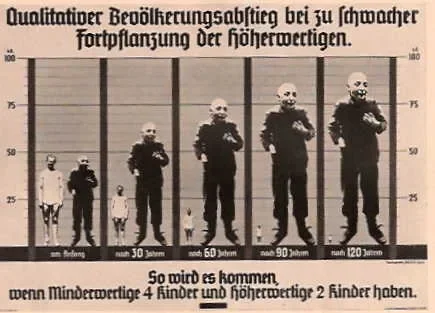
“This poster shows what happens if parents of good racial stock have two children, but those of poor racial stock have four. They begin in equal numbers, but after 120 years the weaker are the overwhelming majority.” - German Propaganda Archive
Meanwhile, community-surveillance campaigns (e.g., The Blockleiter System, The National Socialist Women’s League) transformed everyday citizens into watchdogs, encouraging them to report neighbors for dissent, nonconformity, or perceived impurity.
Nazi propaganda was so crucial to the regime that their ministry of propaganda was created just days after the Nazi electoral victories of March 1933. Propaganda diffused the country’s legal and health systems and public attitudes were swayed in line with the regime’s goals. Once controversial ideology became law, the space for moral questioning evaporated.
Similar messaging approaches were also present in wartime Japan, where, under the banner of communal service, every neighborhood association created for firefighting, ration distribution, and civil defense became a grassroot intelligence network.
Each unit served as a reporting squad to implement the 1940 National Eugenic Law that discouraged marriages between Japanese settlers and colonized citizens, and reported to Special Higher Police on families with mental and physical disabilities. Individuals were defined by their utility to the state. As in the Nazi regime, ideal citizens were racially pure and able-bodied.
Even in university, it was not difficult for me to connect the dots: once a society embraces autocracy, it empowers ordinary people to enforce repression—and sets itself on an inexorable path to self-destruction.
Seeing Propaganda through a Bioethics Lens
Now, immersed in medical ethics and bioethics, I view those historical tactics with new eyes.
What began as community welfare and communal care could morph into state-enforced conformity. In autocratic systems, the very tools once lauded for improving quality of life could be repurposed to strip away autonomy and rational thinking.
Stepping into Courtroom 600
In 2022, I entered Nuremberg’s Courtroom 600 (see the picture I took during my visit).
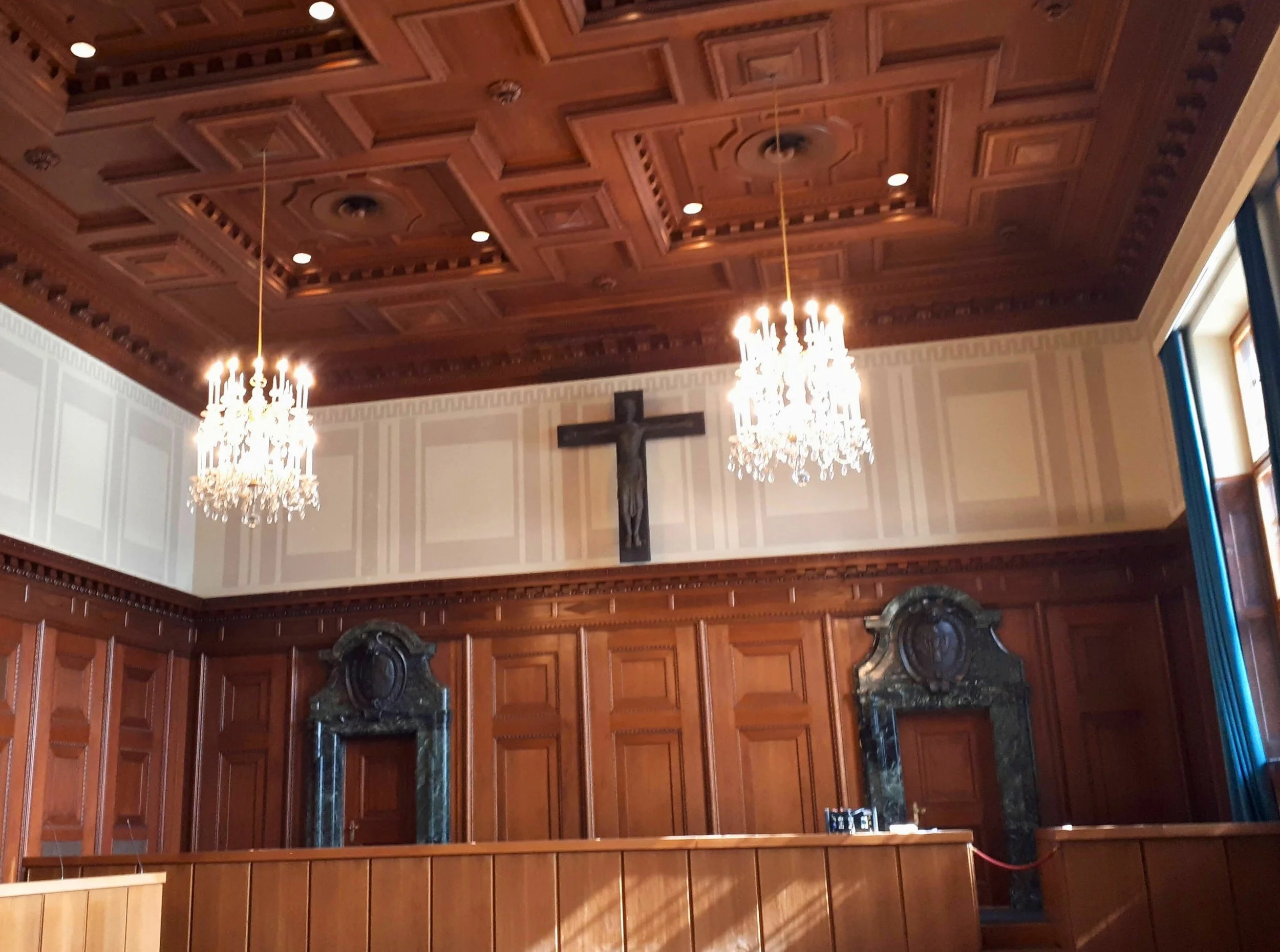
Nuremberg’s Courtroom 600
The Courtroom space felt both intimate and distant. Gentle sunlight filtered through high windows, illuminating wood-paneled benches that once judged war criminals and Nazi doctors who conducted atrocious experiments under the guise of technological advancement.
The air held echoes of thousands of footsteps, the hush of anticipation, the gravity of verdicts that would reshape global clinical ethics for generations to follow.
The Chilling Weight of the Cross
Behind the judges’ bench, a simple cross loomed. The cross that hangs above Courtroom 600 today presided over Nazi-era trials—but was removed during the Nuremberg Trials to preserve judicial neutrality. Its reappearance in the modern courtroom invites reflection. The cross reminded me that Christianity was not only a protective shield for victims of atrocities, but it was also a weapon in the Nazis’ arsenal.
Christian imagery and metaphors in Nazi propaganda were common commodities. Officers leveraged their self-defined faith to recruit and coerce fellow Christians, even deploying scripture to justify executions. For them, Christianity was used as catalyst for complicity:
· Some Nazi officers used denominational ties to mask SS brutality as ‘divine’ mandate.
· Churches, fearing repression, torture, and death, often remained silent or complicit.
Christian networks sometimes enabled the regime’s social-engineering experiments in “racial hygiene.” Exiting Courtroom 600, I reflected on other crosses I have seen in hospitals, public buildings, and churches. They can be both a source of strength and a conduit for moral corruption.
The day after my visit, I took a train to Oberammergau Germany to watch the world-famous Passion Play and learned how the leader of Nazi Germany and his entourage hijacked the story of Christ to spread their hatred of Jewish people in 1934. Was I surprised? …unfortunately not.
Forging Modern Bioethics at Nuremberg
The Trials did more than adjudicate crimes; they birthed a new ethical framework for medical research. Facing the horrors of human experimentation, jurists codified principles to protect individuals from state or scientific overreach.
The Nuremberg Code, established in 1947, is a 10-point statement designed to define the limits of permissible medical experimentation on humans. It emerged from the Nuremberg Military Tribunal. Key principles included the following:
Voluntary consent must be obtained without coercion.
Experiments should be conducted only if there is sound scientific basis for the study.
The risk in conducting the study should be minimized and proportional to anticipated benefits.
Research should be conducted by qualified scientists.
Participants must be free to withdraw at any time.
These tenets remain the bedrock of modern clinical trials and research ethics committees’ protocols worldwide.
Informed consent underpins every clinical interaction, medical research participation, and ethics boards review protocols. Meanwhile, patient advocates ensure understanding, and transparency replaces secrecy.
Reminders from Courtroom 600 warn us that even seemingly benevolent public health campaigns require ethical guardrails as history repeatedly demonstrates that the line between public health guidance and ideological nudging can blur.
Courtroom 600: Lessons for today
Courtroom 600 stands as a living memorial—a place where memory converges with moral imperative. It reminds us that symbols like the cross can be both beacon and blight, and that every public-health initiative carries ethical weight.
As we confront new frontiers such as gene editing, AI, and global pandemics, Courtroom 600’s lessons for bioethics remain poignantly urgent.
We must honor informed consent, not as bureaucratic checkbox but as a covenant of respect for all lives. And we must remember that faith, science, and state are powerful allies or dangerous bedfellows, depending on whose hands guide them.
Standing in that small courtroom, I felt a surge of responsibility. If we forget how easily established guidelines of standard care, communal service and the quest for scientific advancement can become coercion, we risk repeating the darkest chapters of human history. Courtroom 600 challenges us to remain vigilant.
Thank you for reading!
Next week, we will step into the concentration camp’s arrival yard, where prisoners faced not one but two divergent fates: forced labor or immediate extermination.
We’ll trace how the very logic of eugenics and efficiency—what I call, large-scale human sorting nets—became blood-soaked reality beneath the SS’s watchful eyes.
How do we recognize today’s sorting nets before they harden into iron gates?
Stay with us as we confront history’s darkest reckonings and sorting nets in the technology and data-driven 21st century.
