Ethics of Sorting at Concentration Camps and AI
“Arbeit Macht Frei” — “work sets you free.”
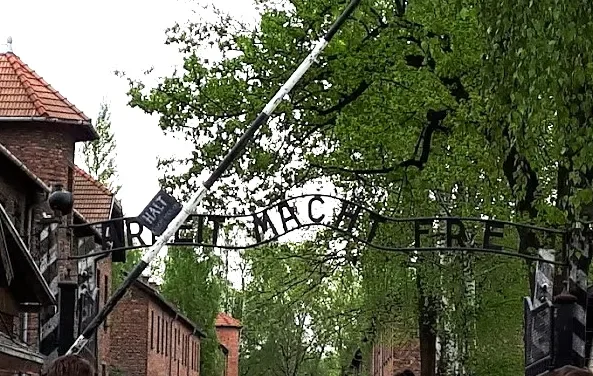
Auschwitz, April 23, 2018
“We are entering the Auschwitz death camp,” explained the Polish tour guide. The infamous iron gate to Auschwitz stretched before us. “People did not arrive here to work. They were brought to be killed in forced labor, torture, and execution.”
Arbeit was one of the first German words that I learned in my freshman year in college. Over the last four decades, my German vocabulary has been reduced to only a few words. Somehow, the word arbeit stayed with me, a product of my introductory German textbook and the days with a Germany study club.
Migrant workers gastarbeiter were brought to post-WWII Germany to help with the reconstruction of the country. Arbeiter means worker. Today, we use the word worker frequently without negative connotations. However, this seemingly neutral word once carried the coded implications of forced labor, torture, and extinction.
Labor in the twenty-first century is no less contentious. Are our lives free of forced labor now? Generative AI is being trained on data from hundreds of thousands of people without their explicit consent.
Think of the advertisements for commercial genetic testing companies like 23andMe. Most users did not provide clear consent for sharing their genetic information with third parties when nudged to participate in seemingly altruistic pharmacogenetics research projects identifying genes associated with risks of developing medical problems.
With the help of our genetic data, the rapid advancement of genetics and genomics is helping to find cures and develop new drugs, and it is already starting to identify genetic defects. In these subtle mechanisms, we are all likely involved in forced labor of different forms without our knowledge or consent.
As the tour guide started walking into Auschwitz, we all stopped talking. One by one, we walked through the gate in utter silence, just as Pope Benedict XVI once insisted on walking alone through these same gates on May 28, 2006. Here, I felt the weight of the message: “Arbeit macht frei.“
Two hours later, I stood at the Death Gate of the Auschwitz II – the rail entrance to Birkenau Concentration Camp. For many prisoners, the Gate meant no return. Our group walked in utter silence again to the place where SS physician Dr. Josef Mengeleand his comrades would control their fates. This time, it was an invisible gate. Here, the arriving prisoners from the death trains would have been presented with two paths: one to the gas chamber, the other to arbeit – forced labor, torture, execution, or pseudo-medical experiments. The labor conducted by prisoners in the concentration camps served multiple utility purposes for the Nazis.
I vividly remember the chilling effect of the invisible gate. Standing on that path, a thought occurred to me. I would have been sent directly to the gas chamber upon arrival. I am short and small-bodied. I would have been useless for simple physical labor. I would not have been selected for labor in skilled trades workshops like metal work. I would have been unhelpful in Nazi infrastructure projects building weapons. I would have not been recruited for Josef Mengele’s pseudo-medical experiments as a subject or an assistant. I am not a twin, dwarf, or a person with the physical anomalies that he was particularly interested in, and I do not have experience in a scientific laboratory.
In fact, being a bioethicist would have thrust me to the frontline of the gas chamber. How would Josef Mengele have reacted if I had called out, “Do no harm!” upon seeing him? As a physician, he would have been familiar with the Hippocratic Oath. Indeed, what if I had shouted, “Thy Shall Not Kill” given his documented Christian upbringing? As a Christian, he would have been familiar with the Fifth Commandment. I concluded that I would have been shot immediately for questioning his moral compass. The duality of his respected profession as the safeguard of life, and the cold-blooded director of the massacres, left me with a deeper reflection on more recent examples of the invisible gate.
From 1945-1946, the Nuremberg trials shed light on Nazi pseudo-medical experiments. In the 1950-60’s, Dr. Donald Ewen Cameron, recruited patients with psychiatric conditions for psychedelic experiments at the Allan Memorial Institute in Montreal — a teaching hospital affiliated with McGill University. While working at McGill, Cameron conducted unethical experiments without informed consent. These experiments were part of the CIA-funded MK-ULTRA project, which was born out of the Cold War-era global security threats to peace.
Cameron was a prominent psychiatrist, holding various global leadership roles in the medical community, being a voice for healing in post-WWII Europe and advocating for psychiatry ethics. Unfortunately, once career ambition and the lure of being at the frontier of science took hold, the ideals of healing, peace and ethics became pliable, and were reshaped and repurposed for the wrong cause. Under the banner of reconstruction, rebuilding, and the rebirth of robust science, the prestige of technological leaps created a climate where extreme methods could be framed as ethical and bold progress. That atmosphere rewarded pioneers even when their work trampled on the very human dignity they once championed.
In 2025, we see the rapid advancement of AI-technology. Imagine if AI-guided embryo selection becomes readily available? What if it soon becomes a standard assistive reproductive technology (ART)? AI algorithms will likely ultimately decide who should be brought into the world. Some companies say parents are already able to choose preferred athletic, intellectual and physical traits, and AI algorithms could make this practice more in-depth and widespread. Would that be advancement or eugenics?
It is unclear of the consequences of a future where our own utility to society is determined by non-bodied AI.
Some modern, large-scale sorting nets are visible and explicit [ e.g., elimination of Down Syndrome]. Others are invisible and implicit [e.g., sex selection through ART]. AI technological advancement is already beginning to play a role in large-scale sorting nets in many fields, replacing humans with AI agents, and is only likely to become more widespread. Sorting nets may be codified into laws. In the Netherlands, euthanasia for healthy seniors aged 75+ (‘Completed’ Life Bill) is gaining public support.
Today, I ask myself simple questions. Would I have been selected to come into this world if I had been conceived in 2025? In the future, will I be allowed to live past 75 free of coercion, nudging, and the pressure to feel my life is already “full”?
Let us not forget the messages of Albeit Macht Frei, the Death Gate, and Josef Mendele’s invisible gate.
Thank you for reading!
I wrote this newsletter on August 15, 2025, the 80th anniversary of Japan's surrender, effectively ending WWII. Next week, I share a piece on the intersection of Nagasaki’s sacrifices and AI-powered nuclear warfare.
Stay with us and share!
